Redfish Fishing Near Flagler Beach
What kind of bait anglers use to catch them.
"*" indicates required fields
Redfish Fishing Near Flagler Beach: Seasons, Habitats & Charter Options
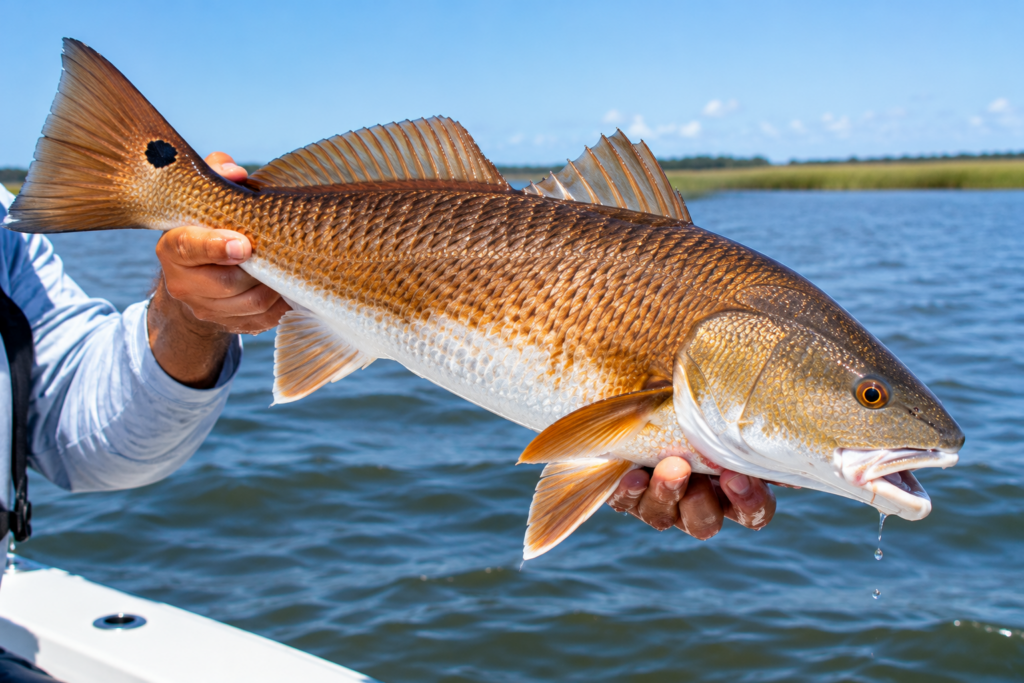
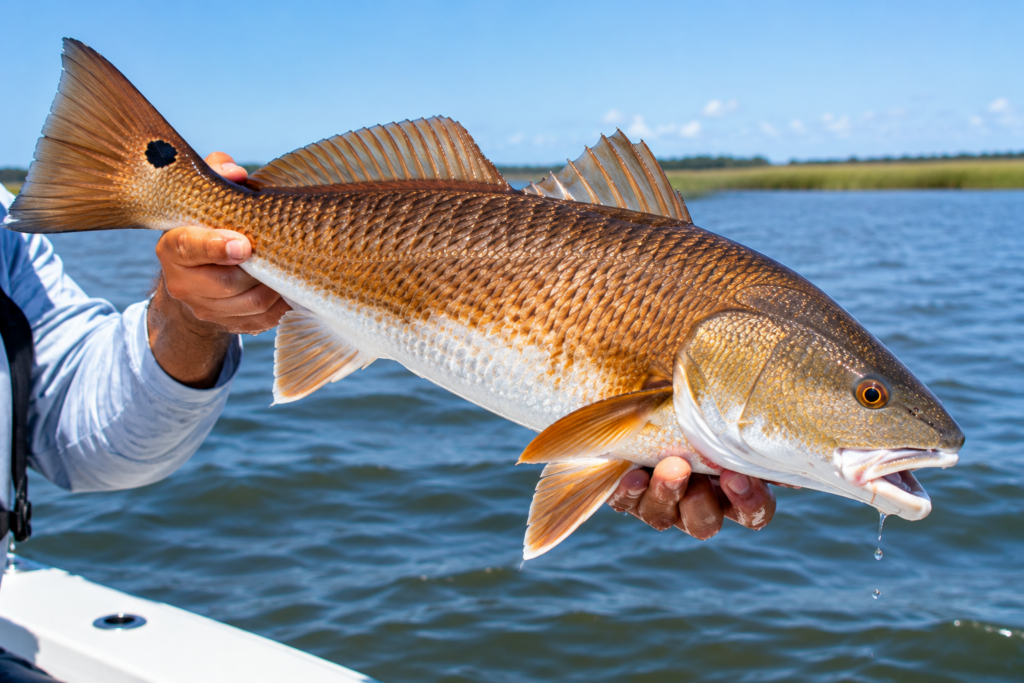
Red drum, better known as redfish, are copper-colored members of the drum family with a black spot near the tail. They are one of the most credible inshore targets near Flagler Beach. The species is documented in the Tomoka River fish survey reported by Tomoka State Park, and redfish appear among the target species on several inshore charter listings for the Flagler Beach, Palm Coast and Ormond Beach area.
Most redfish trips near Flagler Beach take place inshore: in the tidal Intracoastal Waterway, marsh creeks and oyster bars behind the barrier island. Larger adults also move into nearshore ocean water near inlets during the fall spawning season.
This guide covers how to identify redfish, where they live locally, what they eat, when conditions may favor them, how anglers commonly fish for them, the rules to check and what to ask before booking a trip. It is a planning resource, not a fishing report, and no trip can guarantee a catch.
Redfish at a Glance
| Feature | Details |
| Common name | Red drum; widely called redfish. Large adults are often called “bull reds” by anglers |
| Scientific name | Sciaenops ocellatus |
| Key identification | Copper-red to nearly silver body, lighter belly, usually one black spot near the tail base (sometimes several), no chin barbels |
| Relevant habitats | Tidal creeks, marsh edges, oyster bars, seagrass, mud and sand bottoms, river mouths and nearshore waters |
| Natural foods | Small crustaceans and worms when young; fish, crabs and shrimp as they grow |
| Seasonal considerations | Present inshore much of the year; juveniles move deeper in winter; adults spawn near inlets from late summer through fall |
| Relevant trip types | Mainly inshore; some nearshore opportunities in fall |
| Ask the operator | Is redfish a realistic target on my dates? Inshore or nearshore? What size fish are typical? |
Size note: The Florida Museum lists a reported maximum length of about 61 inches and weight just under 100 pounds, and notes that red drum can live at least 50 years. Those are maximums, not normal catches. Many redfish caught inshore are much smaller, and large adults must be released when they exceed Florida’s size limits.
How to Identify Redfish
Body Shape and Color
Redfish have a long body with a slightly arched back and a blunt snout. Their color usually ranges from deep copper to nearly silver, fading to a lighter belly (Florida Museum). Color can look different depending on light, water clarity and the bottom where the fish lived, so don’t rely on shade alone.
The Tail Spot
The best-known feature is a black spot near the base of the tail. Most redfish have one, but some have several (Florida Museum, Mote Marine Laboratory). Scientists suggest the spot may help confuse predators by drawing attacks toward the tail rather than the head.
Mouth and Feeding Anatomy
Redfish have a downward-facing (inferior) mouth with bands of teeth on both jaws, according to the South Carolina Department of Natural Resources. That shape suits a fish that feeds on or near the bottom.
Redfish vs. Black Drum
Redfish are most often confused with black drum, a close relative. The easiest difference is under the chin: black drum have whisker-like barbels on the lower jaw, and redfish don’t (FWC). Black drum are also typically gray to black with a high, arched back, and juveniles carry dark vertical bars.
Identification and the Law
Correctly identifying a fish is only the first step. Whether you may keep it depends on current size limits, bag limits, region and other rules. Check FWC’s red drum regulations before keeping any fish.
Where Redfish Live Around Flagler Beach
A Fish of Many Salinities
Redfish tolerate an unusually wide range of conditions. The Florida Museum notes they can enter fresh water and very salty water, though adults usually stay in typical seawater. That flexibility helps explain why they turn up in so many local habitats.
The Local Inshore Habitats
Flagler Beach sits on a barrier island. Behind it runs the Atlantic Intracoastal Waterway, a tidal, saltwater-influenced lagoon, not a freshwater river. North toward Palm Coast this stretch is called the Matanzas River. To the south, Bulow Creek and the Tomoka River flow into Tomoka Bay, where the Halifax River begins (overview). Palm Coast, Ormond Beach and Tomoka State Park all lie outside Flagler Beach city limits.
Local charter listings that name redfish describe fishing in places such as the Tomoka Basin, Smith Creek and Bulow Creek, around oyster bars, ledges, flats and sunken structure (Capt. Billy’s listing), and in “backcountry brackish waters, creeks, and marshlands” across Volusia, Flagler and St. Johns counties (Capt. Kicen’s listing).
To learn how flats and backwater habitats differ, see our guide to flats vs. backwater fishing in Florida.
Habitat Changes With Age
- Larvae ride tidal currents into tidal creeks and shallow marsh nurseries and settle on seagrass (SCDNR, Florida Museum).
- Juveniles stay near marsh grass edges and oyster reefs and move to deeper river channels in winter.
- Subadults use larger tidal creeks, rivers and beaches.
- Adults use tidal creeks, oyster reefs and beaches over sandy or muddy bottoms, and many move between inshore and nearshore waters during the spawning season.
Structure, Bottom and Moving Water
Oyster bars, marsh edges, docks, creek mouths and drop-offs concentrate the crabs, shrimp and small fish redfish eat. Moving tidal water carries prey along those edges, which is why captains often fish where current meets structure.
Access Notes
Much of this habitat is best reached by boat, especially shallow backcountry creeks. Public launch sites exist, such as the boat ramp and canoe and kayak launch at Gamble Rogers Memorial State Recreation Area on the Intracoastal side of Flagler Beach, and the ramp at Tomoka State Park. Parks set their own hours and rules, so check before you go. Shorelines may be private property, and waters near Tomoka State Park are a designated manatee sanctuary with slow-speed zones.
What Do Redfish Eat?
Diet Changes as Redfish Grow
Redfish diets shift dramatically with size:
- Larvae: zooplankton and tiny invertebrates (SCDNR).
- Juveniles: opossum shrimp, grass shrimp, small fish such as mud minnows and juvenile spot, and mud and fiddler crabs.
- Larger fish: the Florida Museum reports a shift to small bony fish once redfish pass about 8 inches (200 mm).
- Adults: menhaden, spot, anchovies and blue crabs. Mote Marine Laboratory also lists mullet, pinfish and killifish.
How They Feed
Redfish of all sizes forage on or near the bottom (SCDNR). Their downward-facing mouth suits picking crabs and shrimp from mud, shell and grass. Juveniles typically forage along marsh grass edges.
Natural Diet vs. Bait
Anglers often use live shrimp, crabs, small fish or lures that imitate them. Those baits match real redfish prey, but catching a fish on a bait doesn’t prove it’s that fish’s main food. Redfish may strike a lure out of aggression or curiosity as much as hunger.
Practical takeaway: Look for redfish where their prey lives, near marsh edges, oyster bars and shallow flats, and keep baits near the bottom. For more on local food webs, read What Do River Fish Eat Around Flagler Beach?
Best Time to Target Redfish Near Flagler Beach
Three Different Questions
1. When are redfish present? Redfish live in local inshore waters much of the year.
2. When might conditions favor targeting them? That depends on water temperature, tide, wind and clarity more than the calendar.
3. When can you legally keep one? Harvest rules are separate from fishing opportunity. Check FWC’s current rules.
Seasonal Patterns
The patterns below come from regional and statewide research, not local catch records:
- Winter: Juvenile redfish move to deeper inshore channels as water cools (SCDNR). Cold fronts can change where fish hold for days.
- Spring and summer: Warmer water generally brings more prey into creeks and marsh edges. Larger adults that overwintered offshore return to nearshore waters in spring, according to SCDNR.
- Late summer through fall: Adults spawn near tidal inlets, roughly mid-August to mid-November according to the Florida Museum, with a peak in late September and October according to the ASMFC.
Our seasonal calendar covers these patterns alongside other species: [INTERNAL LINK NEEDED: verified seasonal fishing calendar].
Conditions Often Matter More Than the Month
- Tide: Rising water floods marsh grass and lets prey move into cover; falling water drains prey back out through creek mouths. The best stage depends on the spot.
- Rain: Fresh water can lower salinity and muddy creeks (NOAA). Redfish tolerate a wide range, but prey may move.
- Light and clarity: Clear, shallow water makes sight fishing possible; murky water makes it harder.
- Wind: Wind can roughen open water and make shallow flats harder to fish.
Fishing Methods, Baits, and Presentations
Local listings that target redfish describe light tackle, live bait, artificial lures, jigging, topwater fishing, sight casting and fly fishing. The approaches below are common examples, not a single best method.
Live or Natural Bait Near the Bottom
Why it fits: Redfish feed on shrimp, crabs and small fish near the bottom. Bait presented there matches how they feed.
Beginner-friendly: Often the easiest approach for first-timers, because the captain can set up the rig.
Tradeoff: Bait can attract other species, from catfish to small snapper.
Artificial Lures
Why it fits: Soft plastics, jigs and other lures can imitate shrimp and baitfish.
Tradeoff: Lures usually require more casting skill and active retrieval.
Sight Casting in Shallow Water
Why it fits: In clear, shallow water, captains may spot redfish and have anglers cast to them. Capt. Billy’s listing describes hunting and sight casting for redfish in shallow water.
Tradeoff: It depends on light, clarity and wind, and it rewards accurate casting.
Fly Fishing
Some local listings offer fly-fishing gear on request. It can be rewarding but usually suits anglers with some casting experience.
When a Guide Helps
A local captain may know which oyster bars and creek mouths hold fish on a given tide, how recent rain has changed things and how to approach shallow fish without spooking them.
Practical note: FWC advises using circle hooks where practical, noting they are far more likely to hook fish in the mouth, which reduces harm (FWC fish handling). Follow all gear rules.
Inshore, Nearshore, or Offshore: Which Trip Fits This Species?
Inshore Is the Main Setting
For most visitors, redfish are an inshore target. The marsh creeks, oyster bars and Intracoastal shorelines near Flagler Beach match their documented habitat, and local inshore listings name them as a target.
Nearshore Has a Seasonal Role
Adult redfish move between inshore and nearshore waters during the fall spawning season, gathering near inlets (ASMFC). Flagler Beach has no inlet of its own, so nearshore trips typically depart closer to Matanzas Inlet or Ponce de Leon Inlet. Many large adults exceed Florida’s maximum size limit and must be released, so check current limits before your trip.
Offshore Is Not a Redfish Trip
Redfish are not a typical offshore target. A NOAA Fisheries map identifies federal Atlantic waters as a red drum harvest and possession prohibition area.
For help choosing between styles, see [INTERNAL LINK NEEDED: verified inshore vs. nearshore comparison page].
Ask About the Itinerary
Two trips labeled “inshore” can fish very different water. Ask where the captain plans to fish and whether redfish are the main target or one of several possibilities.
Overlooked Details That Help You Understand Redfish
1. Juveniles and Adults Live Different Lives
Young redfish stay mainly in estuaries and river mouths until about three to four years old, then many move toward open coastal waters (Florida Museum). The redfish in a marsh creek and the bull red near an inlet are often at different life stages, with different habits and diets.
2. Marsh Edges Are Nurseries
Juvenile redfish typically forage along marsh grass edges and near oyster reefs (SCDNR). The Nature Conservancy notes that Florida oyster reefs shelter shrimp, blue crab and redfish (TNC fact sheet). Healthy marsh and oyster habitat supports both young fish and the prey they eat.
3. Redfish Make Sound
Red drum are named for the drumming sound males make, which is thought to be linked to spawning (ASMFC).
4. Present Doesn’t Mean Feeding
Redfish can hold near abundant prey and still ignore baits. Feeding can depend on temperature, tide, light, recent meals and spawning condition. This is a reasonable interpretation of general fish behavior rather than a local study, and it explains why a productive spot can go quiet.
5. Tolerance Doesn’t Mean Preference
Redfish can tolerate fresh water and very salty water, but adults usually stay in typical seawater (Florida Museum). Their wide tolerance helps explain why they turn up in so many local habitats, but it doesn’t mean every creek holds them on every day.
Regulations, Handling, and Responsible Fishing
Check the Current Rules
Redfish rules can vary by management region, state or federal waters, sector and date. Flagler County falls within FWC’s Northeast region, which runs from the Florida–Georgia line to New Smyrna Beach. Rules have changed several times in recent years, so check these sources before every trip:
- FWC red drum regulations
- NOAA Fisheries South Atlantic regulations
- FWC saltwater fishing license information
Handling Fish You Release
FWC’s fish handling guidance recommends:
- Handling fish only with wet hands, as little as possible, to protect their protective slime coat.
- Keeping time out of the water short.
- Supporting the weight of larger fish rather than dragging them over the gunwale.
- Cutting the leader close to the hook if a fish is hooked deep, rather than pulling the hook.
- Releasing fish head first into the water.
For large redfish, FWC has also recommended keeping the fish in the water when possible, using tackle strong enough to land it quickly, avoiding gaffs on fish you will release, keeping fingers away from the eyes and gills, and reviving exhausted fish by moving water over the gills (Tampa Free Press, 2021).
Careful handling improves a released fish’s chances, but catch-and-release does not eliminate all harm. Follow your captain’s instructions.
How to Choose a Charter for Redfish
Questions to Ask
- Is redfish a realistic target for my dates?
- Is it the main target or one possible catch?
- Where does the trip depart?
- What type of water will we fish?
- How long is the trip?
- Is it appropriate for beginners or children?
- What equipment and license coverage are included?
- What is the total price?
- What happens if conditions change?
Trips That List Redfish
The listings below name redfish among their target species. They were checked on October 29, 2026. Listings and prices change, and redfish are never guaranteed.
Disclosure: We may earn a commission if you book through links on this page. Bookings are completed by the third-party provider or operator, not by this website.
- Capt. Billy — Fantastic Flagler Beach Inshore (Captain Experiences): 4-, 6- or 8-hour inshore trip in the Flagler Beach area; lists redfish, seatrout, snook and flounder. View trip details [AFFILIATE LINK NEEDED: confirm tracking URL]
- Capt. Kicen — NE Florida Inshore Frenzy (Captain Experiences): 4-hour backcountry inshore trip; lists redfish, black drum and seatrout. View trip details [AFFILIATE LINK NEEDED: confirm tracking URL]
- Capt. Kevin — Family Fishing Adventures (Captain Experiences): 4-hour inshore trip departing Palm Coast; lists redfish, black drum, trout and sheepshead. View trip details [AFFILIATE LINK NEEDED: confirm tracking URL]
- Flagler Fishing Charters (FishingBooker): 4- and 6-hour backcountry trips; lists redfish, snook, trout and flounder. View trip details [AFFILIATE LINK NEEDED: confirm tracking URL]
Departure areas shown are from each listing. Confirm the exact boarding location with the operator. For cost comparisons, see [INTERNAL LINK NEEDED: verified charter-pricing guide]. If you’re staying north or south of Flagler Beach, our Palm Coast and Ormond Beach pages cover those areas.
Frequently Asked Questions
Can you catch redfish near Flagler Beach?
Yes, they are a credible inshore target. Red drum are documented in the Tomoka River survey, and several local inshore charters list them as a target. No trip can guarantee a catch.
What do redfish eat?
Young redfish eat small crustaceans and worms. As they grow, they eat shrimp, crabs and small fish such as menhaden, mullet and pinfish.
What time of year offers suitable opportunities?
Redfish are present inshore much of the year. Winter pushes juveniles deeper, and adults move toward inlets to spawn from late summer through fall. Conditions on the day often matter more than the month.
Is redfish an inshore or nearshore target?
Mostly inshore. Larger adults can also be found nearshore near inlets in the fall.
Can beginners target redfish on a guided trip?
Yes. Many inshore trips welcome beginners, and bait fishing near the bottom is a beginner-friendly approach. Tell the captain your experience level.
Which similar species might redfish be confused with?
Black drum. Black drum have chin barbels; redfish don’t. Redfish usually have a black spot near the tail.
Where should I check current regulations?
On FWC’s red drum page. Rules can change, so check before each trip.
What should I ask before booking a trip?
Ask whether redfish are realistic for your dates, where you’ll board, what’s included, the total price and what happens if weather changes plans.
Planning Your Redfish Trip
Redfish are well suited to the tidal marshes, creeks and oyster bars behind Flagler Beach. Knowing how they feed, how they shift with the seasons and how to identify them helps you choose a trip that fits. Keep in mind that no listing guarantees a fish and that rules change.
When you’re ready, compare relevant fishing trips and view trip details with the booking provider. If you’d like help deciding, you can also request a no-obligation overview.
Contact Us
We would love to hear from you! Please fill out this form and we will get in touch with you shortly.