Inshore vs. Nearshore Fishing
What’s the Difference, What Can You Catch, and Which Fishing Experience Is Right for You?
"*" indicates required fields
Inshore vs. Nearshore Fishing Near Flagler Beach: Which Trip Is Right for You?
Inshore fishing near Flagler Beach takes place in the sheltered, tidal waters behind the barrier island: the Intracoastal Waterway, marsh creeks and nearby rivers. Nearshore fishing goes out through an ocean inlet into Atlantic water within sight of the coast. Inshore trips often suit families, beginners and anyone who wants to stay out of open-ocean swells.
Nearshore trips can suit anglers who want ocean fishing and are comfortable with more exposure to wind and waves. Neither is always calmer, cheaper or more productive. The right choice depends on who is coming, what they want and what the weather is doing that day. Operators also use these labels differently, so check the actual itinerary rather than relying on the trip name.
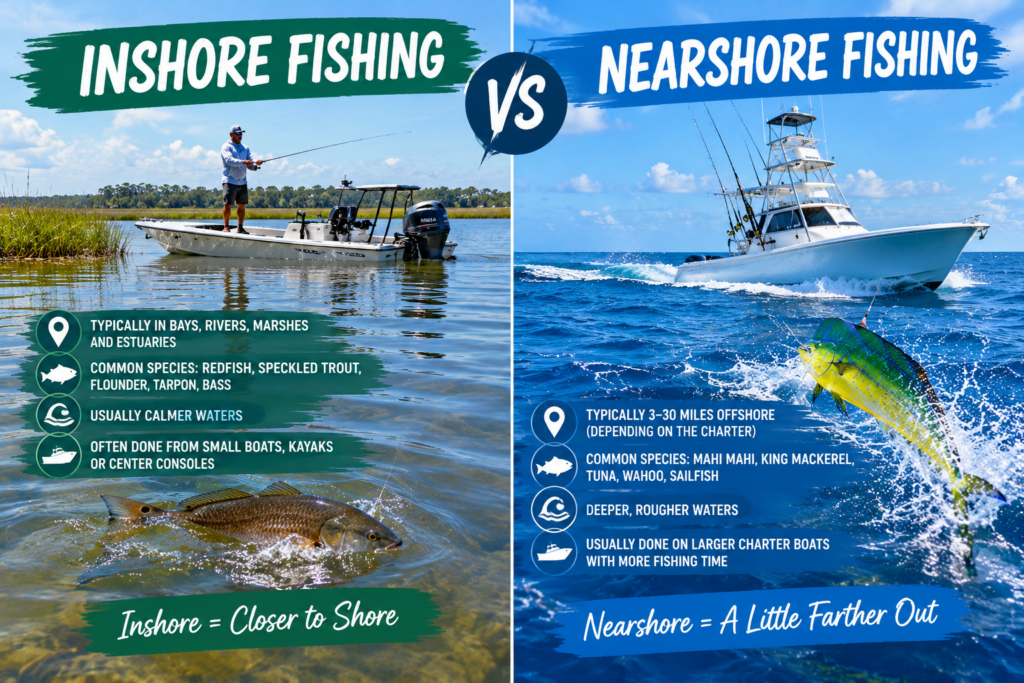
Inshore vs. Nearshore Fishing at a Glance
Flagler Beach Fishing Charters is a planning and referral resource, not a charter boat or captain. Here’s how it works: you share your group and dates, review trip options and then confirm details such as price, trip length and departure point directly with an independent operator. Any operator listings mentioned on this page belong to those businesses.
| Factor | Inshore | Nearshore |
| Typical setting | Tidal Intracoastal Waterway, marsh creeks, rivers and docks behind the barrier island | Atlantic waters reached through an inlet, generally within sight of the coast |
| Exposure to wind and waves | More sheltered, though wind can still make open stretches choppy | More exposed to ocean swells and wind; conditions vary daily |
| Fishing style | Often light tackle, casting, live or artificial bait near structure and marsh edges | Varies by operator; may include bait fishing, trolling or fishing around structure |
| Potential target species | Redfish, spotted seatrout, black drum, sheepshead, flounder; snook and tarpon occasionally | Varies by season and operator; local listings name sharks, tarpon, bonito and kingfish |
| Travel and transit | Fishing water is often close to the launch | Requires running to and through an inlet; boarding often outside Flagler Beach |
| Trip duration | Local listings checked offered 4-, 6- and 8-hour trips | Local listings checked offered 4-hour and longer trips |
| Families and beginners | Often a gentler introduction, but depends on boat, trip length and conditions | Possible for some families; ask about conditions, transit and amenities |
| Motion sensitivity | Usually less ocean motion, but not motion-free | More likely to involve swells; ask about expected conditions |
| Equipment and amenities | Small boats may lack restrooms or shade; confirm | Confirm restroom, shade, seating and capacity |
| Pricing | Depends on length, group size and inclusions | Depends on length, boat, fuel and inclusions |
Your actual trip may differ from this general picture. Ask the operator what their “inshore” or “nearshore” trip involves.
What Is Inshore Fishing Near Flagler Beach?
The Waters Behind the Beach
Inshore fishing near Flagler Beach generally means fishing the protected water between the barrier island and the mainland. The main waterway is the Atlantic Intracoastal Waterway, which runs behind the town. To the north, toward Palm Coast, this stretch is called the Matanzas River. To the south, Bulow Creek and the Tomoka River flow into Tomoka Bay, where the Halifax River begins its run south through Ormond Beach and Daytona Beach to Ponce de Leon Inlet (Halifax River overview). Several of these places, including Palm Coast, Ormond Beach and Tomoka State Park, lie outside Flagler Beach city limits.
Tidal, Brackish and Fresh Water
Inshore does not mean freshwater. Most local inshore water is tidal and salty or brackish, a mix of fresh and salt water whose salinity can change from day to day with tides and weather, according to NOAA. Bulow Creek, for example, is tidal and becomes brackish as it nears the Intracoastal (Florida DEP paddling guide). True freshwater fishing is a separate kind of trip, found farther inland. For more on how these waters differ, see What Do River Fish Eat Around Flagler Beach?
What Inshore Fishing Usually Looks Like
Inshore trips commonly use small, shallow-water boats such as skiffs and bay boats. Local listings describe light tackle, live bait and artificial lures, and fishing around marsh edges, oyster bars, docks and creek mouths. Some trips focus on scanning shallow flats; others work tight to cover in sheltered backwaters. Our guide to the difference between flats and backwater fishing explains both styles.
Not every operator fishes the same areas or uses the same methods. One captain may stay near the launch; another may fish waters from New Smyrna Beach to St. Augustine.
What Affects an Inshore Trip
- Tide: Moving water carries bait and shapes where fish feed. The best tide stage depends on the spot and species, not a universal rule.
- Wind: Sheltered water is not always calm. Tomoka State advises paddlers to avoid the open Tomoka Basin except on very calm days, since it can turn choppy quickly (Florida State Parks).
- Water clarity: Rain can muddy creeks and change how fish hunt.
- Boat traffic: The Intracoastal is a working waterway with recreational and commercial boats. Manatee zones also require slow speeds in some areas.
What Is Nearshore Fishing Near Flagler Beach?
Ocean Fishing Close to Shore
Nearshore trips fish the Atlantic Ocean rather than interior waterways, usually within sight of land. There is no universal mileage or depth cutoff. One Port Orange operator on Captain Experiences describes its nearshore trip as fishing within about three miles of the beach (listing); another Palm Coast listing describes “the nearshore waters of Palm Coast” without giving a distance (FishingBooker). Ask each operator what their trip covers.
Nearshore Is Not the Same as Offshore
Offshore trips run much farther out and usually last longer. One offshore listing departing Matanzas Inlet, for example, describes running roughly 60 miles out on an 8-hour trip (FishingBooker). Nearshore and offshore trips differ in distance, time, boat requirements and cost, so they should not be confused.
Why the Departure Point Matters
Flagler Beach has no ocean inlet. The nearest inlets are Matanzas Inlet to the north and Ponce de Leon Inlet to the south. Nearshore and offshore boats need to reach the ocean through an inlet, so a trip marketed to Flagler Beach visitors may board in Palm Coast, Ponce Inlet or another nearby community. Running to and through an inlet also takes time away from fishing.
Routes Change With Conditions
Ocean conditions shape where a nearshore boat can go. A captain may change the route, shorten the run or cancel if wind and swells make conditions unsafe. Some captains offer mixed trips that combine inshore and nearshore water; one Flagler Beach–area listing advertises fishing “the reefs and flats” depending on conditions (Captain Experiences).
What Fish Might You Target on Each Trip?
Presence, targeting and legal harvest are three separate things. A fish may live in local waters without being a realistic target on a given day, and a fish you can target may be in a closed harvest season, which means it must be released. Advertised target species are never a guaranteed catch.
Mostly Inshore Species
Redfish (red drum): Found along marsh edges, oyster bars and tidal creeks. Adults move nearshore near inlets to spawn from late summer through fall (ASMFC), so they can appear in both settings.
Spotted seatrout: Use grass flats in warm months and deeper estuary pockets when water cools (Florida Museum).
Black drum: Bottom feeders around oyster beds, docks and bridge pilings (FWC).
Sheepshead: Feed around pilings, docks and tidal creeks. They gather around structure in cool weather and move offshore to spawn, mainly in February and March, according to UF/IFAS Extension research from southwest Florida.
Flounder: Florida’s flounder rules cover four species. In 2025, recreational harvest was closed October 15 through November 30 (WJHG). Confirm current dates.
The species above are documented in the Tomoka River, where a Florida Marine Research Institute survey recorded 90 fish species (Florida State Parks).
Species That May Appear in Either Setting
Tarpon: Documented in the Tomoka River survey, and listed as a target on a Palm Coast nearshore trip. Treat tarpon as an occasional, seasonal possibility rather than a dependable target.
Common snook: Documented in the Tomoka River, but they cannot survive water below about 60°F (FWC). Northeast Florida is near the cool edge of their range.
Nearshore Species
Local nearshore listings name sharks, tarpon and bonito (Palm Coast) and kingfish, or king mackerel (Flagler Beach–area mixed trip). Migratory fish such as Spanish mackerel, king mackerel and cobia move along the Atlantic coast with the seasons (ASMFC, SCDNR, GCFI). How close they come to Flagler County in any given week depends on water temperature and bait.
For current rules, see FWC saltwater regulations and, for federal waters, NOAA Fisheries South Atlantic regulations.
Which Option Is Better for Families and Beginners?
Inshore trips are often a gentler first experience, but neither option is automatically right or safe for every family. The specific boat, captain, itinerary and conditions matter more than the label. Use these as questions to confirm with the operator, not features every boat provides:
- Children’s ages and attention spans: Is there a minimum age? Is a shorter trip available? One local listing welcomes ages 5 and up; others don’t state an age.
- Experience: Will the captain teach casting and handling fish?
- Trip length: Most local listings checked start at 4 hours. Ask whether shorter options exist.
- Hands-on participation: Will kids reel in fish themselves?
- Shade and seating: Small inshore boats may have little shade.
- Restroom access: Several small inshore boats in local listings have no restroom on board.
- Capacity: How many people does the price include, and how many fit comfortably?
- Life jackets: Are child sizes available, and will they fit your children?
- Accessibility: Several local listings say their trips aren’t suited for guests with disabilities. Ask about boarding and seating needs.
- Sun and weather: What should you bring for heat, sun or a sudden shower?
Families can ask which trip fits their group. For more planning help, see [INTERNAL LINK NEEDED: verified family or beginner charter guide].
What If You Are Concerned About Seasickness?
Sheltered water usually means less ocean swell, but inshore trips can still involve boat motion, wind chop and wakes. Nearshore ocean conditions vary from flat to rough, sometimes within a single day. No trip type eliminates seasickness.
If you’re concerned:
- Tell the operator before booking.
- Ask about expected conditions and how long the boat will spend running.
- Ask whether a shorter or more sheltered itinerary is available.
- The CDC suggests focusing on the horizon and notes that motion-sickness medicines can cause drowsiness.
- Talk with a pharmacist or healthcare professional before using any motion-sickness medication.
How Do Trip Length and Costs Compare?
The examples below are advertised booking-platform listings, checked October 28–29, 2026. They are not quotes. Prices, inclusions and policies can change, so confirm everything with the operator.
| Operator and trip | Type | Duration | Advertised price | Pricing basis | Departure area |
| Capt. Billy, Fantastic Flagler Beach Inshore | Private inshore | 4 hrs | From $399 | $399 for 1 person up to $549 for 4 | Flagler Beach |
| Capt. Kicen, NE Florida Inshore Frenzy | Private inshore | 4 hrs | $500 | Per trip, 1–2 people | Flagler Beach (flexible pickup) |
| Capt. Kevin, Family Fishing Adventures | Private inshore | 4 hrs | $550 | 1–2 people; +$50 each, up to 6 | Palm Coast |
| Capt. Kicen, NE Florida Flats and Reefs | Private inshore/nearshore | 6 hrs | $700 | Per trip, 1–2 people | Flagler Beach (flexible pickup) |
| Manolos Guide Service, Half Day Trip – Nearshore | Private nearshore | 4 hrs | $550 | Entire boat; shown for 2; capacity 3 | Palm Coast |
In this small sample, 4-hour inshore and nearshore trips overlapped in price. That doesn’t mean they always will. Costs can differ because of trip length, boat size, fuel, distance traveled, passenger count, inclusions and fishing style. A shared, per-person trip and a private, per-boat trip are different products and shouldn’t be compared as equivalents.
Read our full pricing guide here: [INTERNAL LINK NEEDED: verified charter-pricing guide].
How Do Seasons, Tides, and Weather Affect the Choice?
The Best Option Changes With the Day
A trip that makes sense in June may not suit January. Inshore species shift with water temperature; nearshore migrations come and go. Our seasonal calendar covers these patterns month by month: [INTERNAL LINK NEEDED: verified seasonal fishing calendar].
Tide Matters Inshore
In the Intracoastal and tidal creeks, tide stage affects water depth, current and where bait gathers. Which tide works best depends on the spot and the species.
Wind and Seas Matter Offshore
For nearshore trips, wind direction, wind speed and swell decide whether a run is comfortable or even possible. The National Weather Service publishes marine forecasts for coastal waters from St. Augustine to Flagler Beach out 20 nautical miles, along with other zones from its Jacksonville office.
Weather Can Affect Both
Thunderstorms, lightning and strong fronts can affect inshore and nearshore trips alike. The Atlantic hurricane season runs June 1 through November 30 (NOAA NESDIS).
A good forecast doesn’t guarantee a trip will run, and a poor one doesn’t guarantee cancellation. The captain makes the final call. Don’t assume an inshore alternative, reschedule or refund is automatically available. Ask about the operator’s weather policy before booking.
Where Will Your Trip Actually Depart?
Four places can get mixed up when booking:
1. Where you’re staying: For example, a rental in Flagler Beach.
2. Where the charter markets itself: A listing may say “Flagler Beach” because it serves visitors there.
3. Where you actually board: This could be a ramp or marina in Palm Coast, Ormond Beach, Ponce Inlet or elsewhere.
4. Where you fish: One listing says the captain fishes waters from New Smyrna Beach to St. Augustine.
Among the local listings checked, departure areas included Flagler Beach, Palm Coast and Matanzas Inlet, but exact boarding addresses were generally not published. One captain offers flexible pickup from St. Augustine to Daytona Beach. Nearby area guides include St. Augustine and Ormond Beach.
Before booking, confirm:
- The exact meeting address.
- Arrival time.
- Parking.
- How long the boat runs before fishing.
- Accessibility at the dock or ramp.
- Whether weather can change the meeting point.
How to Choose the Right Trip for Your Group
Decision Guide
- You may prefer inshore if your group includes young children or first-time anglers, if anyone is sensitive to motion, or if you want fishing close to the launch.
- You may prefer nearshore if your group is comfortable on open water, wants ocean fishing and is flexible about weather.
- Ask about mixed trips if you’d like both, with the route set by conditions.
Four Hypothetical Scenarios
These are illustrations, not quotes or promises.
1. A family with young or first-time anglers. Two parents and two kids want a relaxed introduction. A shorter inshore trip in sheltered water could suit them. They ask about life jackets in children’s sizes, shade, restroom access and how hands-on the captain will be.
2. A couple wanting a shorter introduction to local fishing. A couple wants a few hours on the water without a full day’s commitment. A 4-hour private inshore trip priced for one or two people could fit. They compare what each listing includes.
3. A group comfortable discussing ocean conditions with the captain. Three friends want ocean fishing. They ask about the departure inlet, transit time, expected conditions and what happens if wind forces a change of plan.
4. An experienced angler focused on a species or technique. An angler wants to fly fish or chase a particular species. They ask whether that species is realistic for their dates, what tackle is provided and whether the trip is inshore, nearshore or mixed.
Quick Checklist
☐ Who is coming?
☐ What experience do they have?
☐ What do they want from the trip?
☐ How much time is available?
☐ What comfort or accessibility needs matter?
☐ What is the total budget?
☐ Where can they realistically travel to board?
☐ What alternatives does the operator offer?
Packing for the trip? See [INTERNAL LINK NEEDED: verified what-to-bring guide].
Questions to Ask Before Booking
Copy this into your inquiry:
“We are staying near Flagler Beach and have [number] adults and [number] children. We are interested in fishing on [date]. Based on our experience and comfort level, would you suggest an inshore or nearshore trip? Where would we board, how long is the trip, what is included, what is the total price, and what happens if conditions affect the itinerary?”
Also ask:
- What does “inshore” or “nearshore” mean for this particular trip?
- How much time is normally spent traveling versus fishing?
- Which species are realistic targets for the date?
- What amenities are available?
- What are the current weather and cancellation terms?
Frequently Asked Questions
What is the main difference between inshore and nearshore fishing?
Inshore fishing takes place in sheltered, tidal waters such as the Intracoastal and marsh creeks. Nearshore fishing takes place in the ocean, generally within sight of land.
Is inshore fishing always calmer?
No. It’s usually more sheltered, but wind, boat wakes and open stretches of water can still make it choppy.
Is nearshore fishing the same as offshore fishing?
No. Offshore trips run much farther out, usually for longer and at higher cost. Ask how the operator defines each.
Which trip is better for first-time anglers?
Many beginners start inshore, but the right choice depends on the group, the boat and the day’s conditions.
Can children join either type of trip?
Some operators welcome children on both. Ask about age limits, life jackets, shade, restrooms and trip length.
Does nearshore fishing always mean bigger fish?
No. Fish size depends on species, season and luck. Large redfish, black drum and tarpon can be found inshore.
Is inshore fishing less expensive?
Not always. In the small sample checked, 4-hour inshore and nearshore trips overlapped in price.
Can the same fish be caught in both settings?
Yes, some can. Redfish and tarpon, for example, can be found inshore and nearshore at different times.
Do these trips depart directly from Flagler Beach?
Some inshore listings show Flagler Beach as their area. Ocean trips typically board closer to an inlet, such as Palm Coast or Ponce Inlet. Confirm the exact location.
Can an operator change the trip because of weather?
Yes. Captains make safety decisions, and routes, timing or the trip itself may change. Ask about the operator’s policy in advance.
Choosing the Trip, Not the Label
Inshore and nearshore trips each have their place. Inshore water is often a more sheltered, accessible introduction; nearshore trips open up ocean fishing with more exposure to conditions. The best choice comes from matching the actual itinerary, boat and departure point to your group, not from the trip’s name alone.
Ready to compare options? Request a free, no-obligation trip overview and ask which trip fits your group.
Contact Us
We would love to hear from you! Please fill out this form and we will get in touch with you shortly.